The 2026 Gartner Emerging Tech Impact Radar: Generative AI opens with a sentence that in our view should stop every technology buyer mid-scroll: “Generative AI is facing a validation hurdle as, despite surging investment in associated technologies, returns frequently lag behind expectations, highlighting an urgent need for proven value.”
But the same report projects a rapid build-out of the technology category that exists to supply exactly that proof: “By 2028, 99% of agent platform providers will offer simulation environments, up from less than 25% in 2026.”
That category is intelligent simulation, and Gartner plots it with very high mass and a range of three to six years to early majority. Mass, in Radar terms, is the breadth and depth of impact when a technology lands. Very high means every industry, every business function.
Gartner’s definition is precise: intelligent simulation is a design pattern delivered as a platform, combining domain expertise with AI, use-case-specific technologies, and targeted services. Through continuous ingestion and curation of data, it optimizes and automates scenarios and decisions across both physical and digital systems.
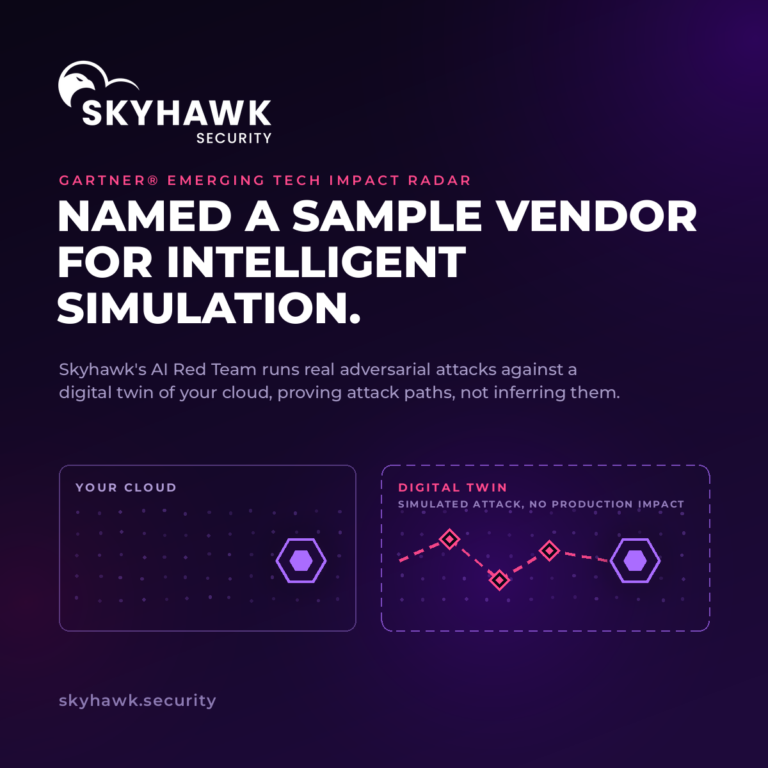
Skyhawk Security is listed as a Sample Vendor for intelligent simulation in the report. We feel Skyhawk has delivered intelligent simulation since December 2023, as a core component of its AI-based security platform.
Skyhawk’s point of view on intelligent simulation and cloud security
For cloud security teams, the operational disruption that intelligent simulation exists to anticipate has a precise name: a breach. The market shift driving it is the emergence of AI-augmented threat actors capable of executing automated, multi-step attacks at machine speed. The value of intelligent simulation in this context is the ability to predict, before a breach occurs, which attack paths exist, which assets are at risk, and which security controls will fail to stop a determined adversary.
Skyhawk’s platform applies that pattern to cloud security: domain expertise (cloud architecture and attacker behavior) combined with AI and agentic technologies (the AI Red Team), operating continuously against a digital twin of the real environment, to predict and prevent the outcomes that matter most to the business. Three interlocking capabilities make it work and each is a departure from how the market solves the problem today.
Adversarial AI red teaming, not graph inference. Skyhawk maintains a continuously updated digital twin of the live cloud environment including its architecture, workloads, identities, security controls, and the relationships between them, kept current in real time as the cloud changes. The AI Red Team then operates against that twin, executing adversarial attack simulations that mirror real threat actor behavior: dynamic manipulation of cloud assets, abuse of misconfigured identities, lateral movement across cloud services, and the chaining of individually low-severity exposures into high-impact attack paths. Where CNAPPs infer attack paths statically, Skyhawk proves them. Because the twin lives inside the SaaS platform, production and people are unaffected, and the attacks are generated by adversarial AI rather than pre-scripted playbooks.
Weaponization-based prioritization tied to asset value. Every finding is ranked not by technical severity alone, but by the business value of the asset ultimately at risk. Skyhawk delivers validated, weaponized threats with attack plan analysis attached, so security teams focus effort where it matters most for true cloud risk reduction, cutting CNAPP alert noise by up to 99%. That matters in an environment where critical findings routinely take three to four months to remediate.
Closed purple-team loop with rehearsed response. Each simulated attack step is mapped to a detection indicator, ensuring compensating controls exist while dev teams work through remediation. Responses are then rehearsed in the digital twin to confirm they halt the attack without breaking production. The result turns unpatchable posture debt into trusted runtime coverage.
Summary
Skyhawk Security delivers intelligent simulation in a digital twin of your cloud, modeling production to determine what threat actors could exploit to breach you, without touching your live environment. Most recently, Skyhawk was able to dynamically manipulate legitimate configurations to achieve full AWS Org takeover.
Gartner subscribers can read the full report at https://www.gartner.com
Gartner’s Emerging Tech Impact Radar: Generative AI by Annette Zimmermann, Anushree Verma, Ray Valdes, Danielle Casey, Aakanksha Bansal, Vibha Chitkara, Radu Miclaus, Roberta Cozza, Russ Hendy, Alizeh Khare, Tuong Nguyen, Kiumarse Zamanian, Arnold Gao, Ethan Cai, Omar Ansari, Aapo Markkanen, Initiatives: Technologies and Markets on August 7, 2026.
GARTNER and Hype Cycle are trademarks of Gartner, Inc. and its affiliates. Gartner does not endorse any vendor, product or service depicted in its research publications, and does not advise technology users to select only those vendors with the highest ratings or other designation. Gartner research publications consist of the opinions of Gartner’s business and technology insights organization and should not be construed as statements of fact. Gartner disclaims all warranties, expressed or implied, with respect to this research, including any warranties of merchantability or fitness for a particular purpose.