Every week brings another critical CVE, another emergency directive, another record-setting Patch Tuesday. If you read these headlines and then find one of those CVEs in your own environment, it’s natural to worry.
Nobody wants vulnerabilities in their environment, and they should be patched. But a vulnerability is only a danger if an attacker can reach it and use it. That leads to the question most security teams never ask:
Can this vulnerability be weaponized against your cloud?
A record number of CVEs, and very few exploited
Look at the numbers behind this month’s headlines.
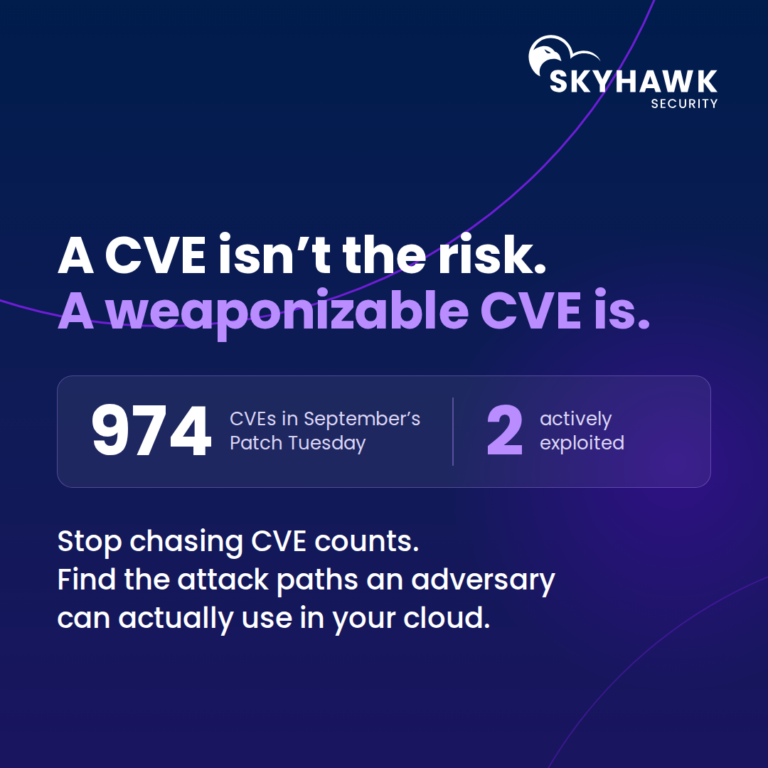
Microsoft’s September Patch Tuesday fixed 974 CVEs, its fourth record-breaking month in a row. Only two of them were being actively exploited. That’s about 0.2%. Microsoft rated 58, or roughly 6%, as likely to be exploited at all. Even the experts quoted in the coverage made the same point: prioritize by what’s exploitable in your environment, not by the raw CVE count.
Severity scores tell a similar story. The September 20 CVE Brief led with five groups of critical CVEs scored between 9.1 and 9.9. Exploitation was confirmed for only two groups. Three Oracle middleware flaws scored 9.8 to 9.9 but had no confirmed exploitation. Cisco’s Secure Email Gateway and Identity Services Engine flaws scored slightly lower, at 9.5, and were already under active attack.
The pattern also runs the other way. Among the seven flaws CISA recently added to its Known Exploited Vulnerabilities catalog was a Starlette request-smuggling bug rated only CVSS 6.5. A severity score tells you how bad a flaw could be. It doesn’t tell you whether an attacker can use it against you.
Attackers chain vulnerabilities together
The CISA additions also show how real attacks work. The attackers didn’t rely on a single CVE:
- They harvested admin tokens from JFrog Artifactory.
- They abused flaws in the AI infrastructure platforms LiteLLM and Kestra to steal API keys.
- They used those keys to stay in the environment, collect database credentials, and deploy crypto miners.
Each step opened the door to the next one.
That’s why reachability matters more than the CVE count. A critical CVE that no attacker can reach is a line item on a report. A medium-severity CVE that sits on a path to your crown-jewel data is a potential breach. The only way to tell them apart is to understand how an attacker would move through your cloud.
Skyhawk Security showed that a CVE is not even required! Skyhawk’s AI Red Team was able to dynamically manipulate legitimate configurations and then chain them together to achieve a full AWS Org take over. That is game over. That is the power of AI.
AI makes chaining attacks faster
Chaining steps together used to be slow, skilled, manual work. It isn’t anymore.
From Skyhawk’s June Blog: The Gartner® June 2026 report Build Preemptive Security to Avert Weaponized AI Risks, by the Emerging Tech and Trends Security Research Team, opens with a statement that, we feel, leaves no room for ambiguity:
“Product leaders who neglect strategic AI security roadmaps as a key component of competitive AI race plans face imminent, career-damaging cyber incidents and crippling market share losses within the next two to four years. Bad actors are already weaponizing AI, unleashing an arsenal of unprecedented sophistication against unprepared enterprises.”
When AI-driven attackers can find and chain exploitable paths in seconds, the only defense that keeps up is one that finds those paths first. At Skyhawk Security, we built an AI-based preemptive cloud security platform for exactly this reality.
How Skyhawk Security answers the weaponization question
An adversarial AI Red Team, not a scripted playbook
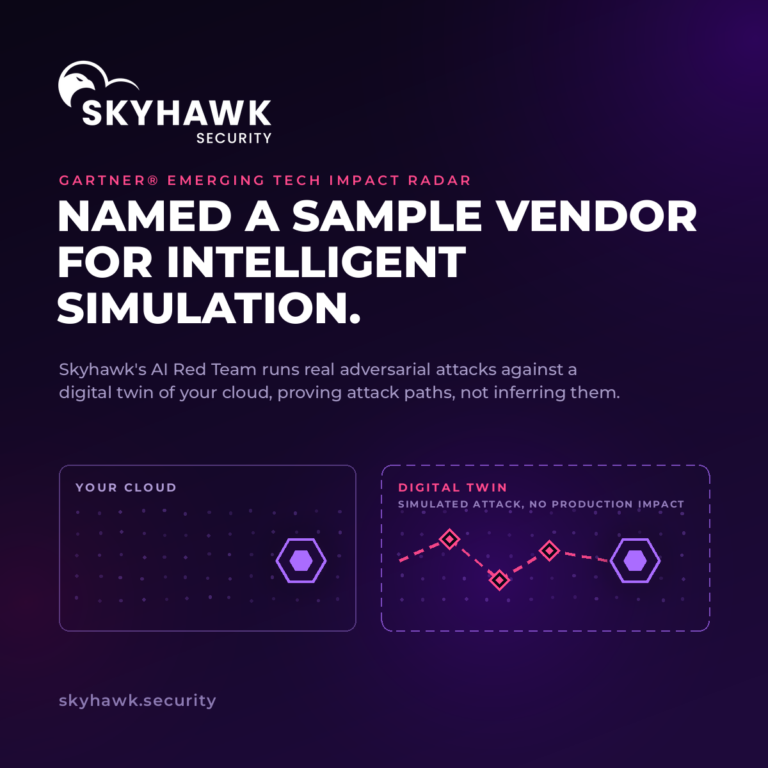
The Skyhawk AI Red Team runs simulations against a digital twin of your cloud inside the Skyhawk SaaS platform. Your production systems, and the people who run them, are never touched.
Adversarial AI generates each attack instead of replaying a pre-scripted playbook. Every attack is built around the cloud architecture and security controls you actually have in place. When those change, the attacks are regenerated. Your risk is always prioritized against your environment as it is today, not as it looked at your last assessment.
In our opinion, this aligns with Gartner’s observation: “Organizations increasingly require systems capable of dynamic attack path exploration, multistep reasoning, and real-time plan correction to uncover vulnerabilities and business logic flaws.”
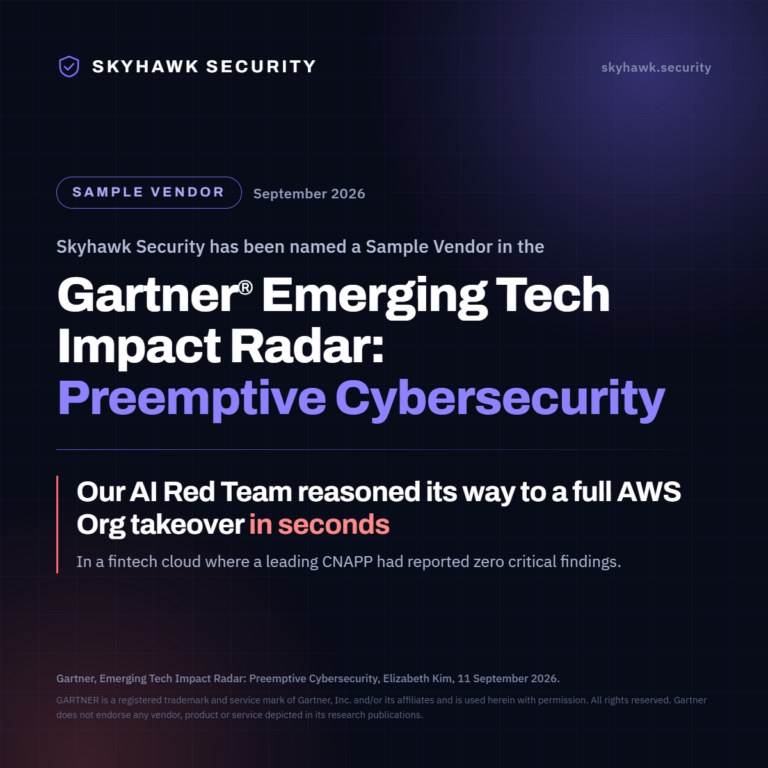
The results are concrete. In our latest research, the AI Red Team reasoned its way to a complete AWS Organization takeover in seconds, in an environment its CNAPP had rated as having zero critical findings.
This changes the question CISOs and security leaders should be asking. It’s no longer “How many known techniques do you cover?” It’s “Can you reason about my environment and show me what an autonomous attacker could actually do inside it, today and again tomorrow?” Skyhawk Security is ready to answer that question. Another blog post covers the difference between AI red teams that reason and those that replay.
Prioritization based on weaponization and asset value
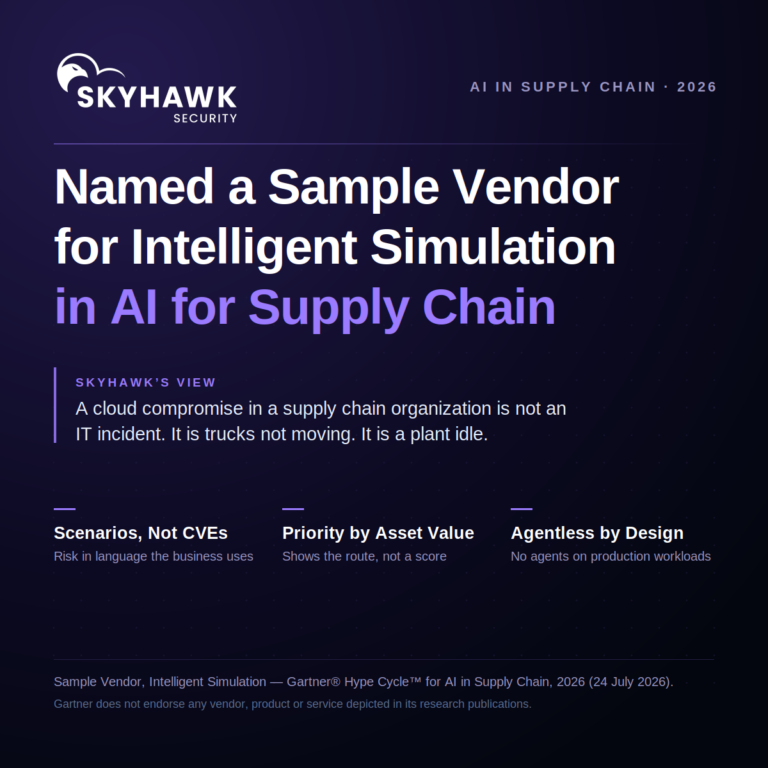
Skyhawk’s Intelligent Simulation shows you the threats that are validated and weaponizable against your most valuable business assets. It doesn’t rank theoretical exposures by severity score.
That means the 974-CVE months stop being a crisis. Your team works on the handful of findings an attacker could actually use, not the thousands they couldn’t. For one customer, Skyhawk Security reduced CNAPP alerts by 99.7%, leaving a short list of findings that make a real difference to cloud risk.
A continuous purple-team loop with rehearsed response
Every simulated attack step is mapped to a detection indicator. That puts compensating controls in place while development teams work through remediation.
Responses are then rehearsed in the digital twin to confirm they stop the attack without breaking production. Vulnerabilities you can’t patch right away are still covered at runtime while they wait. And because simulations run continuously, your cloud security controls stay validated as your architecture changes.
Find what CVEs and even what legitimate configurations can lead to a breach.
The next record-setting Patch Tuesday is only a few weeks away. You can’t patch everything at once, and you don’t have to. You need to know which vulnerabilities an attacker could actually use against your cloud, and close those paths first.
Skyhawk Security also proved, you don’t need a CVE to breach your cloud. An AI-enabled threat actor will find a way to gain access through legitimate configurations to achieve full AWS Org take over.
Book a meeting to learn how Skyhawk’s AI Red Team can help you prepare for the AI-enabled threat actor and prevent cloud breaches.