Skyhawk Security is listed as a Sample Vendor in the Intelligent Simulation profile of the Gartner Hype Cycle for Emerging Technologies, 2026.
The Category Is the Story
Skyhawk is a cloud security company. We could reasonably have expected to appear on a security Hype Cycle, next to other security vendors, in a category defined by the threats we defend against. Instead, we’re in a profile about simulation, sitting alongside companies from engineering, life sciences, industrial design and supply chain.
In Skyhawk’s view, that is the more accurate placement, and it says something about where cloud security is going.
For most of its history, security tooling has been fundamentally retrospective. Something happens, telemetry is collected, a rule or a model decides whether the thing that happened was bad, and an analyst is paged. Even posture management, vulnerability scanning, attack path analysis have largely been about producing static inventories of things that are theoretically wrong. The list gets longer every quarter. Nobody can work it.
Simulation breaks that pattern, and I think that is why the industry’s center of gravity is quietly shifting toward it. The question stops being what is misconfigured in my cloud and becomes what would actually happen if someone tried. Those are not the same question, and only the second one is actionable at 2 a.m.
Intelligent Simulation is the Foundation for Autonomous Business
Of everything written in the Intelligent Simulation profile, there is one paragraph that stands out:
“Adoption and unification of AI, agentic, and simulation solutions are resulting in a range of advanced capabilities that provide greater outcomes than any singular technology. Though nascent, intelligent simulation is the culmination of this trend, with implementations that deliver highly targeted insights by autonomously integrating and contextualizing multimodal data from corporate silos to determine optimal decisions through simulation. It acts as the foundation for future autonomous business.”
Read that from a security seat and I think it lands differently than it does from an operations or engineering seat.
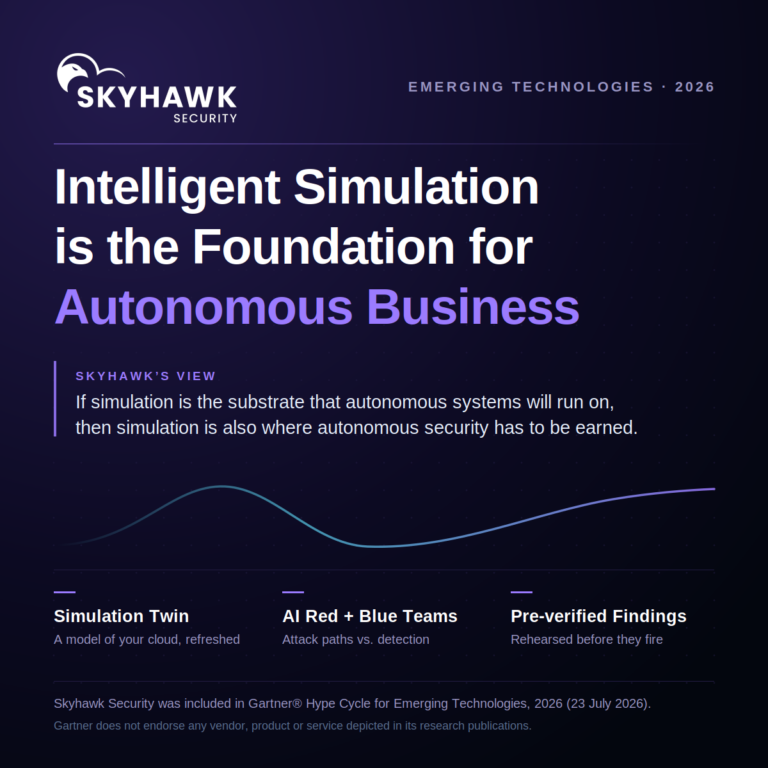
In Skyhawk’s opinion, if simulation is the substrate that autonomous systems will run on, then simulation is also where autonomous security has to be earned. An agent that can act on your cloud without a human in the loop is only as trustworthy as the environment in which its judgment was tested. You cannot validate an automated response by deploying it into production and hoping. You have to run it somewhere safe, against a faithful model of the specific environment it will eventually act on, enough times that you know what it does before it does it.
In Skyhawk’s opinion, that statement the strongest link between what Gartner describes and what Skyhawk has been building. Our Autonomous Purple Team runs AI-based red and blue teams against a Simulation Twin of the customer’s own cloud, not a generic reference architecture, not a benchmark, but a model of that environment, refreshed as it changes. The red side maps the least-resistance paths to the assets that actually matter to the business. The blue side tries to catch it. The gap between them is the finding. And because the detection and the response were rehearsed before they ever fired, what reaches the security team is pre-verified rather than probable.
The distinction that matters is between simulation as a report and simulation as a control loop. A one-off assessment tells you where you stood on a Tuesday. A continuous loop that re-runs as your cloud changes, and that hands validated responses to the systems that will execute them, is infrastructure. Skyhawk’s opinion is that the second definition is the one the market is converging on, and it’s the one worth building toward.
Skyhawk Security Overview: Stop AI Autonomous Attacks with Intelligent Simulation
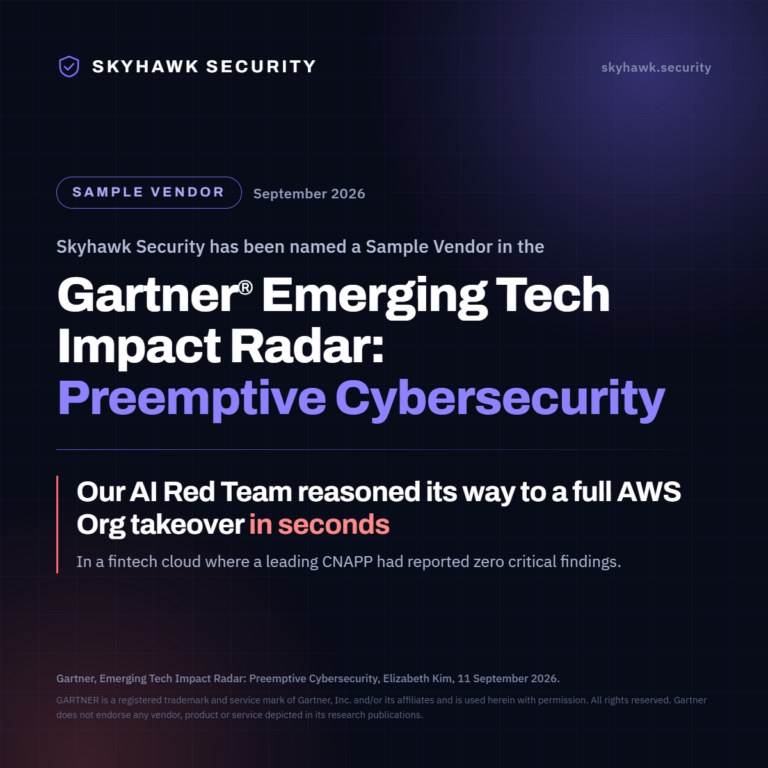
Skyhawk Security’s AI Red Team ran intelligent simulations against a digital twin copy of a Fintech’s cloud and was able to achieve a full AWS organization take over in seconds. What was shocking is there were no critical vulnerabilities, no serious alerts across any of their security platforms, and permissions and roles were managed appropriately. Skyhawk’s AI Red Team was able to dynamically manipulate legitimate configurations in the cloud to achieve a full AWS Org take over. That is game over.
Skyhawk’s key differentiators are:
Adversarial AI red teaming, not graph inference. CNAPPs infer attack paths statically. Skyhawk proves them. Simulations run against a digital twin of the customer’s cloud inside the SaaS platform, so production and people are unaffected, with attacks generated by adversarial AI rather than pre-scripted playbooks.
Weaponization-based prioritization tied to asset value. Skyhawk delivers validated, weaponized threats ranked by the business value of the at-risk asset, with attack plan analysis attached, reducing CNAPP alert fatigue by up to 99% against a baseline where critical findings take three to four months to remediate.
Closed purple-team loop with rehearsed response. Each simulated attack step is mapped to a detection indicator, ensuring compensating controls exist while dev teams work through remediation. Responses are then rehearsed in a simulation twin to confirm they halt the attack without breaking production and turning unpatchable posture debt into trusted runtime coverage.
Want to learn more? Book a meeting today!
Gartner subscribers can read the full report at https://www.gartner.com
Gartner’s Hype Cycle for Emerging Technologies, 2026 by Christian Stephan, Frank Buytendijk, Samantha Searle, Gene Alvarez, Bin Li, Owen Chen on July 23, 2026.
GARTNER and Hype Cycle are a trademark of Gartner, Inc. and its affiliates. Gartner does not endorse any vendor, product or service depicted in its research publications, and does not advise technology users to select only those vendors with the highest ratings or other designation. Gartner research publications consist of the opinions of Gartner’s research organization and should not be construed as statements of fact. Gartner disclaims all warranties, expressed or implied, with respect to this research, including any warranties of merchantability or fitness for a particular purpose.