The next phase of cybersecurity will not be defined by whether artificial intelligence can find vulnerabilities. That threshold has already been crossed. The defining question is whether defenders can move from knowing about exposures to neutralizing them before attackers can convert them into working paths of compromise.
Frontier models can discover more weaknesses, reason across more code, and generate exploits with increasing fluency. AI changes the economics of attack faster than it changes the mechanics of defense. For cloud security leaders, this distinction matters. The most dangerous adversary is not always the elite operator with unlimited resources. Increasingly, it is the ordinary attacker augmented by extraordinary automation: an actor who can ask an AI system to inspect code, prioritize exploitable conditions, chain misconfigurations, and iterate until something breaks. In cloud environments, where identity, permissions, APIs, workloads, SaaS integrations, third-party dependencies, and data stores all interact at machine speed, that kind of automation turns isolated weaknesses into attack narratives.
Gartner® states: “The biggest change from LLM-driven vulnerability discovery is not the need for more speed; it is the need for more scale.”
In our opinion, that sentence should be pinned to every CISO dashboard. Speed still matters, but speed alone is not enough. A team can patch faster and still lose if it cannot understand which exposures matter most, which identities can reach them, which workloads depend on them, and which cloud paths allow them to become business-impacting incidents. The future of defense belongs to teams that can reason at the level of attack paths, not isolated alerts.
The “Exploit” Gap is really an “Automation” Gap
Traditional vulnerability management was built around a familiar rhythm: scan, score, ticket, prioritize, patch, verify. It was imperfect, and works at people-speed. Security teams could debate severity, developers could negotiate deadlines, and operations teams could schedule maintenance windows. This process assumes that attackers were constrained by time, skill, and effort. This is no longer the case.
An AI-enabled threat actor uses a model that can interpret code, test assumptions, generate proof-of-concept logic, and refine exploit attempts. The work required to become dangerous is compressed to a few prompts. That compression is what should worry defenders most.
Mythos’ capabilities are much more focused exploit creation than reliable fix generation. That asymmetry is the heart of the problem. Finding and exploiting a weakness is often a narrower task than fixing it safely across production environments. A fix must preserve business logic, avoid regression, pass testing, respect change windows, and coexist with the messy reality of legacy systems. The attacker needs a door. The defender has to remodel the building while people are still inside.
“The cost of running extensive vulnerability analysis, the false positive rate and the ability to generate fixes, not exploitation, will be the determining value for LLM-based vulnerability assessment.”
This is where cloud security must evolve. The question is not whether organizations will use AI to scan more. They will. The question is whether that scanning will create clarity or chaos. A thousand new findings do not make a company safer if they become a thousand new tickets with no understanding of exploitability, reachability, blast radius, or business priority.
Cloud Risk is Chained Risk
In the cloud, breaches do not follow a single straight line. They look more like a sequence of small permissions, weak assumptions, forgotten trust relationships, exposed credentials, overprivileged service roles, unmonitored APIs, and vulnerable workloads. Each issue may seem tolerable in isolation. Together, they form a story an attacker can follow.
AI is especially powerful at turning fragments into stories. A human analyst might see a vulnerable package, a permissive role, an exposed endpoint, and a supplier integration as separate findings living in separate tools. An AI-assisted attacker can treat them as steps in a campaign. It can ask: What can this identity access? What can this workload assume? What external service is trusted? What data store becomes reachable if this container is compromised? What path leads from low privilege to meaningful control?
| Defender challenge | Why AI makes it harder | What cloud security must do differently |
| Vulnerability overload | AI can generate more findings faster than teams can triage them. | Prioritize based on exploitability, reachability, weaponization, identity context, and business impact. |
| Exploit acceleration | Attackers can iterate on proof-of-concept logic with less expertise. | Detect attack behavior early, especially reconnaissance and privilege movement. |
| Supply chain exposure | AI can map dependencies and trusted relationships at scale. | Continuously assess third-party paths into cloud assets and sensitive data. |
| Human-speed response | Manual ticket queues cannot match automated attack loops. | Automate validation, routing, containment, and remediation workflows where safe. |
| Fragmented tooling | Separate tools create separate truths. | Correlate vulnerabilities, identities, configurations, runtime behavior, and data exposure. |
This is the strategic opening for modern cloud detection and response. Defenders need systems that do not merely list what is wrong but explain what an attacker can do with it. The operational advantage comes from moving from static exposure inventories to active risk narratives: the specific chains that connect an exposure to a likely compromise outcome. This is what an AI-enabled attacker can accomplish. It can see what can be dynamically manipulated to breach your cloud.
The Answer is Autonomous Exposure Defense
The security industry has spent years teaching teams to count risk. Count vulnerabilities. Count misconfigurations. Count failed checks. Count critical alerts. But in an AI-accelerated threat landscape, counting is not defending. Attackers do not exploit dashboards. They exploit paths.
A more resilient model begins with three principles. First, prioritize what is actually exploitable in your environment, not what is theoretically severe in a generic scoring system. Second, understand cloud context deeply enough to know whether a vulnerable asset can reach sensitive data, assume dangerous roles, or interact with critical workloads.
“As LLM-driven exploits become easier with models like Claude Mythos, cybersecurity leaders must speed up patching and scale their roadmap efforts, moving faster toward autonomous exposure remediation.”
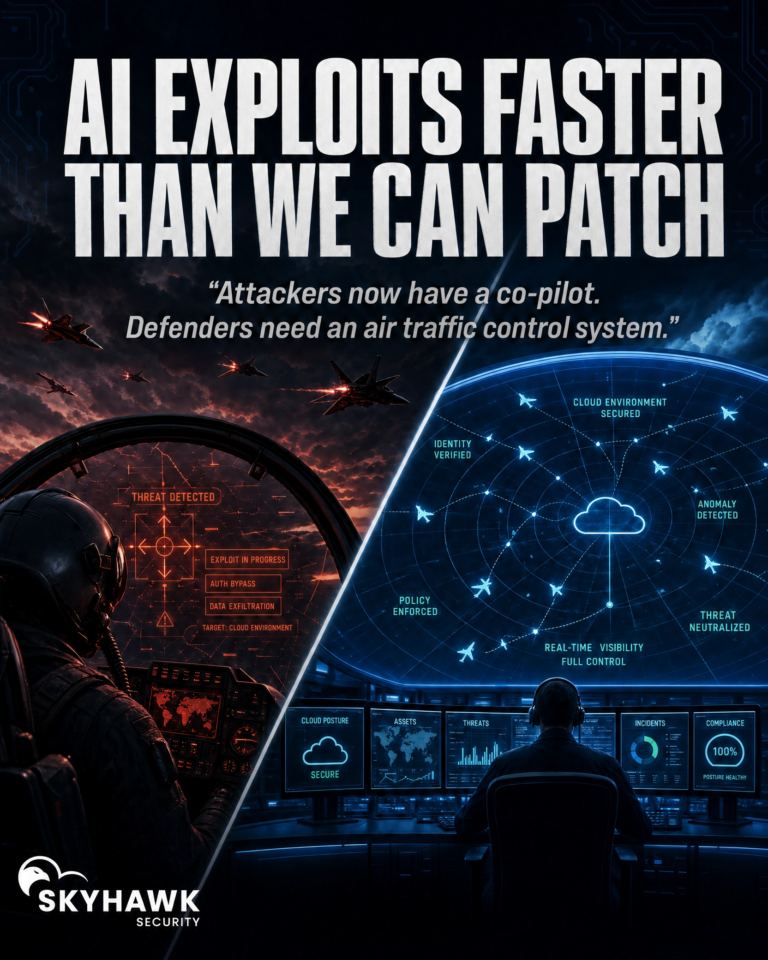
In Skyhawk’s Opinion, Attackers now have a co-pilot. Defenders need an air traffic control system.
There is a useful metaphor in aviation. A co-pilot helps fly one plane. Air traffic control understands the whole sky. AI gives attackers a co-pilot: something that can help them navigate code, refine tactics, and find a route through complexity. Defenders need the equivalent of cloud air traffic control: a system that sees the entire environment, understands where the dangerous routes are forming, and directs response before collision becomes catastrophe.
This is the mindset Skyhawk Security was built around: cloud attacks are dynamic, contextual, and path-driven. The winning defense is not the biggest pile of alerts. It is the clearest view of how an attacker could move, what they could reach, and which actions would break the chain fastest.
The age of AI-assisted exploitation will reward organizations that treat cloud security as a living system. Vulnerabilities will keep appearing. Models will keep improving. Attackers will keep automating. But defenders who combine context, prioritization, detection, and safe remediation can turn the same force that accelerates risk into the engine of resilience.
The future is not exploit versus patch. It is automation versus automation. The side that understands the cloud attack path first will have the advantage, and AI-enabled threat actors are already ahead of your cloud security team.
How Skyhawk Security can help?
Skyhawk Security’s AI-based Cloud Security Platform prevents cloud breaches. The Autonomous Purple Team identifies the attacks methods, techniques, and paths that threat actors will use in your cloud. It shows how assets can be dynamically manipulated.
The Platform has three main capabilities:
The Digital Simulation Model
At the core of Skyhawk’s platform is a continuously updated digital simulation twin of your live cloud environment. This is not a static snapshot or a periodic scan. It is a dynamic, living model that reflects your cloud architecture, your deployed workloads, your identity configurations, your security controls, and the relationships between all of them — updated in real time as your cloud changes.
The twin serves a critical purpose: it gives Skyhawk’s AI Red Team a safe, accurate environment in which to simulate adversarial behavior without touching production systems. Every change to your cloud, a new IAM role, a modified security group, a newly deployed workload, is reflected in the twin, ensuring that simulations are always current and architecturally accurate. In a cloud environment that changes hundreds of times per day, this continuous fidelity is not a feature. It is a prerequisite for meaningful security validation.
The AI Red Team
Skyhawk’s AI Red Team operates continuously against the digital twin, executing intelligent attack simulations that mirror the behavior of real threat actors, including AI-augmented ones. These are not generic, template-based penetration tests. They are custom simulations, built to reflect the specific architecture, security controls, and asset topology of your cloud environment.
The simulations include the full range of attacker behaviors that define modern cloud intrusions: the dynamic manipulation of cloud assets to establish footholds, the abuse of misconfigured identities and overprivileged roles to escalate permissions, lateral movement across cloud services and accounts, and the chaining of individually low-severity exposures into high-impact attack paths that lead directly to your most valuable business assets.
Critically, the AI Red Team simulates the behavior of an attacker who is using AI. It does not assume a slow, methodical human adversary. It assumes an adversary that can enumerate your environment at machine speed, identify the most efficient path to a high-value target, and exploit identity and configuration weaknesses in ways that bypass controls designed for human-speed attacks. This is the threat model that matters in 2026.
Business-Value Driven Prioritization
Not all cloud assets are equal. A misconfigured storage bucket containing marketing collateral is a different risk than a misconfigured identity with access to your customer database or your financial systems. Skyhawk’s platform understands this distinction.
Every exposure, identity risk, posture gap, and simulated attack path is prioritized not merely by technical severity, but by the business value of the asset at risk. Skyhawk maps the blast radius of each simulated attack to the assets it would ultimately compromise and weights the urgency of remediation accordingly. Security teams receive a clear, ranked picture of what matters most, not a flat list of thousands of findings sorted by CVSS score.
This business-value lens extends to identities and cloud assets alike. Skyhawk continuously evaluates which identities have access to high-value assets, which of those identities carry exploitable weaknesses, and which combinations of identity misconfigurations and cloud posture gaps create viable attack paths. The result is a security posture that is aligned with what the business actually cares about protecting, not just what is technically misconfigured.
Book a meeting today to learn how Skyhawk Security responds to AI-attacks at machine speed.
Gartner subscribers can read the full report at https://www.gartner.com.
Gartner, First Take: With Claude Mythos Preview, Anthropic Shows that Creating Exploits is Easier Than Creating Fixes by Jeremy D’Hoinne, Dionisio Zumerle, Dennis Xu, Charlie Winckless published April 21, 2026.
GARTNER is a registered trademark and service mark of Gartner, Inc. and/or its affiliates in the U.S. and internationally and is used herein with permission. All rights reserved.