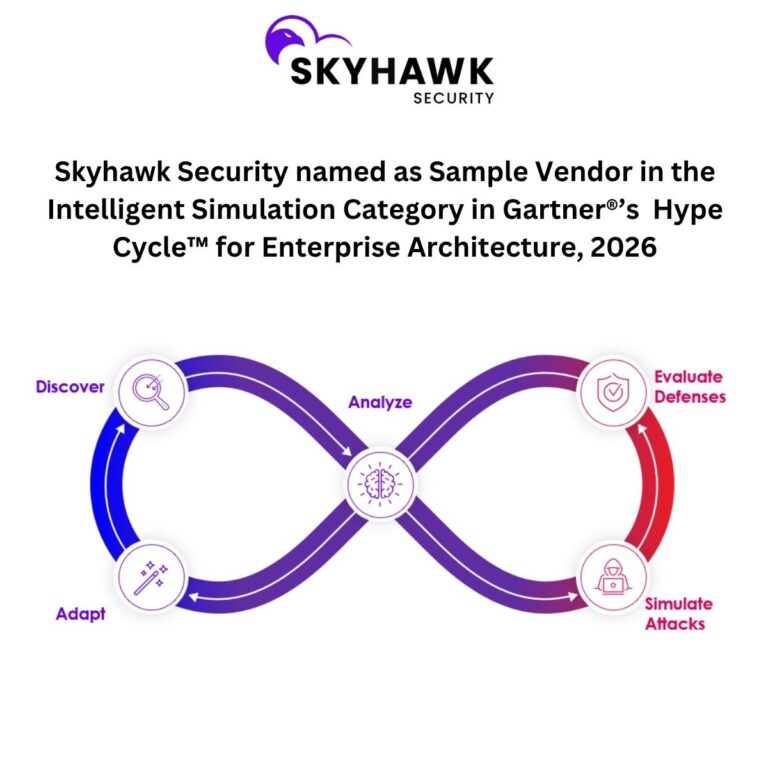
Gartner’s Hype Cycle for Enterprise Architecture, 2026 names Skyhawk Security as a Sample Vendor in the Intelligent Simulation category.
In our opinion, this inclusion is a signal about where cloud security is heading. Intelligent simulation is not a security-specific category. It spans manufacturing, pharmaceuticals, supply chain, and operations. The fact that a cloud security company appears in this list reflects something important: the way Skyhawk has built its platform, a continuously updated digital model of a live cloud environment, driven by an AI red team executing adversarial attack simulations, is architecturally aligned with the defining characteristics of intelligent simulation. Skyhawk is not simply a security tool. It is an intelligent simulation platform applied to the domain of cloud security.
Gartner’s Definition: Intelligent Simulation
“Intelligent simulation is a design framework that integrates domain expertise with AI, agentic, and use-case-specific technologies to provide greater optimization of business goals and prediction of outcomes than traditional simulation solutions.”
In Skyhawk’s opinion, three elements of this definition are worth examining in the context of cloud security. First, the integration of domain expertise with AI: intelligent simulation is not generic AI applied to a problem, but AI that is deeply informed by the specific rules, behaviors, and failure modes of a given domain. Second, the emphasis on agentic technologies: systems that can act autonomously, iterate, and adapt based on what they observe. Third, the focus on optimization of business goals: the output of intelligent simulation is not a raw data stream, but a targeted, actionable insight aligned to what the organization is trying to protect or achieve.
Skyhawk believes each of these characteristics describes our approach to cloud security.
“Though nascent, intelligent simulation is the culmination of this trend, with implementations that deliver highly targeted insights by autonomously integrating and contextualizing multimodal data from corporate silos to determine optimal decisions through simulation. It acts as the foundation for future autonomous business.”
Skyhawk’s Point of View on Intelligent Simulation and Cloud Security
From Skyhawk’s perspective, the operational disruption has a precise name: a breach. The “market shift” is the emergence of AI-augmented threat actors capable of executing automated, multi-step attacks at machine speed. The value of intelligent simulation in this context is the ability to predict, before the disruption occurs, which attack paths exist, which assets are at risk, and which security controls will fail to stop a determined adversary.
Skyhawk’s platform delivers this through three interlocking capabilities. The digital simulation model is a continuously updated model of the live cloud environment, its architecture, workloads, identities, security controls, and the relationships between them, maintained in real time as the cloud changes. The AI Red Team operates against this digital model, executing adversarial attack simulations that mirror real threat actor behavior: dynamic manipulation of cloud assets, abuse of misconfigured identities, lateral movement across cloud services, and the chaining of individually low-severity exposures into high-impact attack paths. And business-value-driven prioritization ensures that every finding is ranked not by technical severity alone, but by the business value of the asset ultimately at risk, so security teams focus effort where it matters most for true cloud risk reduction.
This is intelligent simulation applied to cloud security: domain expertise (cloud architecture and attacker behavior) combined with AI and agentic technologies (the AI Red Team), operating continuously against a digital model of the real environment, to predict and prevent the outcomes that matter most to the business.
The Broader Context
The Hype Cycle report frames Intelligent Simulation as part of a broader imperative for enterprise architecture leaders to capitalize on disruption with emerging technologies. Gartner notes that intelligent simulation, which unites digital twins, GenAI and advanced analytics to model complex physical or digital process systems, delivering dynamic “what if” scenarios that give organizations a significant business advantage during disruptive shifts.
Summary
In the cloud security domain, the disruptive shift is well underway. AI-powered threat actors are no longer a future risk, they are a present one, documented in real attacks observed in 2025 and 2026. The FortiGate incident, in which an AI-augmented attacker compromised over 600 devices across 55 countries without using a single zero-day, demonstrated that AI does not make mediocre attackers sophisticated. It makes them dangerous at scale.
The organizations that will navigate this shift successfully are those that adopt the foundation of intelligent simulation: continuous, autonomous modeling of their environment, combined with the ability to simulate adversarial outcomes before they occur. This is not a periodic exercise. It is an ongoing operational capability.
Gartner subscribers can read the full report at https://www.gartner.com
Gartner’s Hype Cycle for Enterprise Architecture by Gilbert van der Heiden, Andrei Razvan Sachelarescu Published on May 19, 2026.
GARTNER and Hype Cycle are a trademark of Gartner, Inc. and its affiliates. Gartner does not endorse any vendor, product or service depicted in its research publications, and does not advise technology users to select only those vendors with the highest ratings or other designation. Gartner research publications consist of the opinions of Gartner’s research organization and should not be construed as statements of fact. Gartner disclaims all warranties, expressed or implied, with respect to this research, including any warranties of merchantability or fitness for a particular purpose.