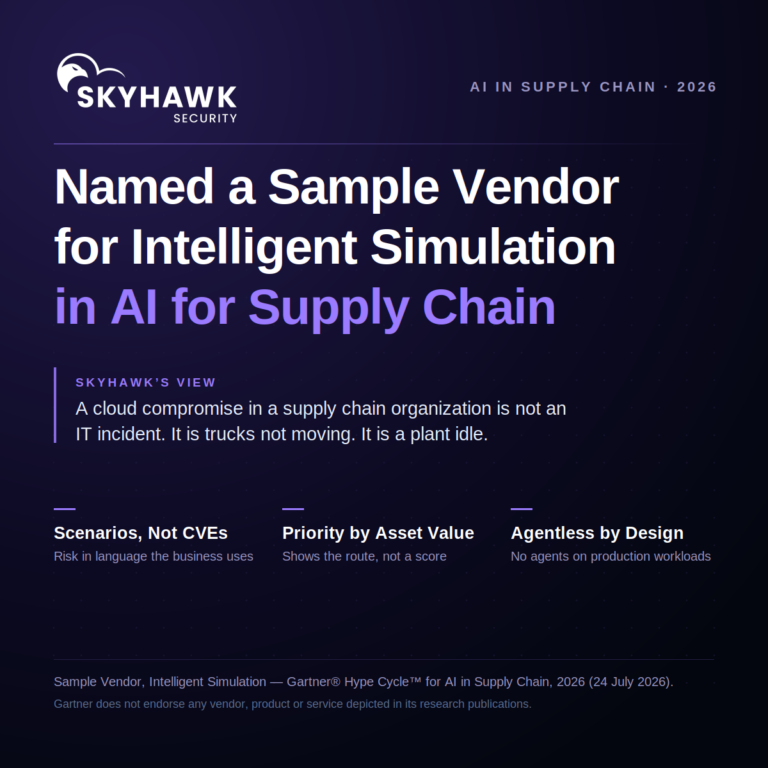
Skyhawk Security is listed as a Sample Vendor in the Intelligent Simulation profile of the *Gartner Hype Cycle for AI in Supply Chain.
Here is the thing about modern supply chains that I think still gets underweighted in security conversations: they are cloud estates now. The WMS, the TMS, the planning platform, the supplier portals, the API integrations with carriers and 3PLs and customs brokers, the telemetry coming off the fleet and the floor, all of this lives in someone’s cloud account, and increasingly in several accounts belonging to several companies who trust each other by necessity rather than by verification.
Which means a cloud compromise in a supply chain organization is not an IT incident. It is trucks not moving. It is a plant idle. It is a customer promise missed, with a physical, expensive, publicly visible consequence attached to it. My view is that supply chain leaders have started to understand this faster than the security industry has adapted to it.
The line that connects the two halves of this report
Of everything in this Hype Cycle, the sentence I keep returning to is one about barriers to scale. Gartner writes: “Barriers: Agent interactions, orchestration, governance and security represent barriers — and opportunities — for enterprise-scale adoption. I want to sit with the word and in that sentence, because I think it is doing a lot of work.”
Let’s sit with the word “and” in that sentence, because it is doing a lot of work.
Skyhawk’s opinion is this: security is not being described as a tax on AI adoption in the supply chain. It is being described as one of the things that determines whether adoption reaches scale at all. That framing matches what I see in the field. Proof-of-concepts don’t usually die because the model was wrong. They stall at the point where someone has to sign off on letting an autonomous system take action against production systems, and nobody can answer the question “what happens if this goes wrong, or if someone makes it go wrong on purpose?”
This question cannot be answered in a policy document. In Skyhawk’s opinion, you can only answer it by testing it, repeatedly, somewhere it’s safe to be wrong.
That’s the bridge, and in Skyhawk’s view, it’s why a security company ends up in a simulation profile rather than a security one. If simulation is where autonomous supply chain decisions get validated before they execute, then simulation is also where the security of those decisions has to be validated. Same discipline, same substrate, different question.
What this looks like when you point it at a supply chain’s cloud
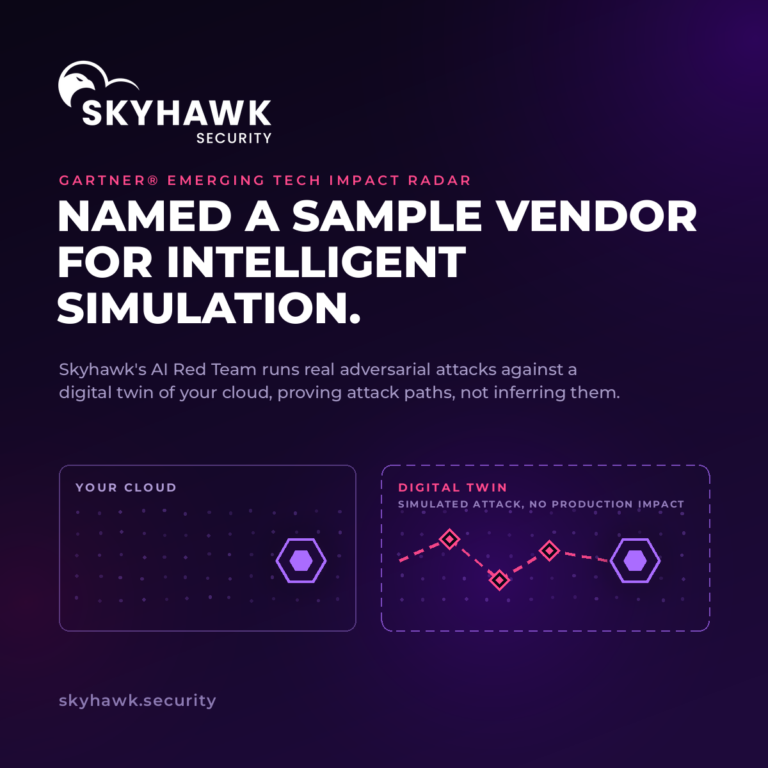
Skyhawk’s Autonomous Purple Team runs AI-based red and blue teams against a Simulation Twin of a customer’s own cloud environment. The red side hunts for the least-resistance paths to the assets that actually matter. The blue side tries to stop it. What the security team receives is not a list of theoretical misconfigurations but a demonstrated path, with a detection and a response that have already been rehearsed against that specific environment.
In our opinion, there are three things about why Skyhawk fits supply chain organizations particularly well.
It speaks a language the business already uses. Supply chain leaders have modelled scenarios for decades such as demand shocks, supplier failure, port closures, route disruption. Presenting cyber risk as a simulated scenario with an operational outcome, rather than as a CVE count, puts security into a conversation the planning team is already fluent in, and this can change how quickly it gets funded.
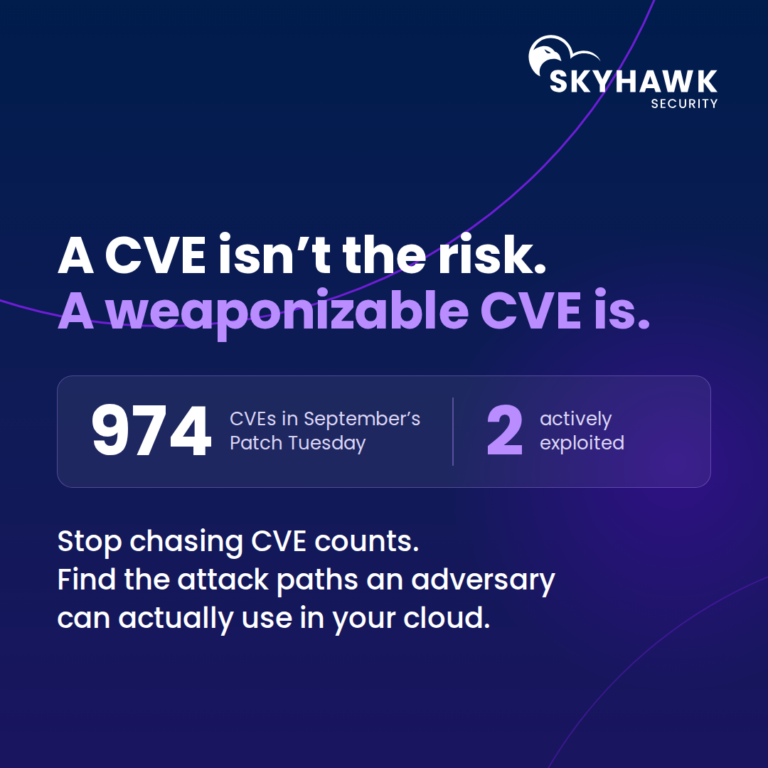
Prioritization has to follow business value, not severity scores. Two identical weaknesses are not equally urgent when one of them sits in front of the system that releases shipments. Simulation is unusually good at making that case, because it can show the route rather than assert the risk.
Deployment friction is disqualifying. Supply chain environments are heterogeneous, partly legacy, and often can’t tolerate agents on production workloads. Agentless matters here for practical reasons, not architectural purity.
Where I think this goes
Skyhawk’s opinion is that this first-edition Hype Cycle is telling supply chain leaders something useful: the constraint on AI at scale isn’t going to be the AI. It’s going to be whether the surrounding conditions, such as orchestration, governance, security, are solid enough to let anyone say yes.
We believe the way you get there is preemptive: knowing what an attacker would do in your cloud before they do it, with the answer already tested. Being the security name on a supply chain vendor list suggests that argument is starting to land somewhere new.
Skyhawk Security’s Latest Use Case: AWS Org Take Over
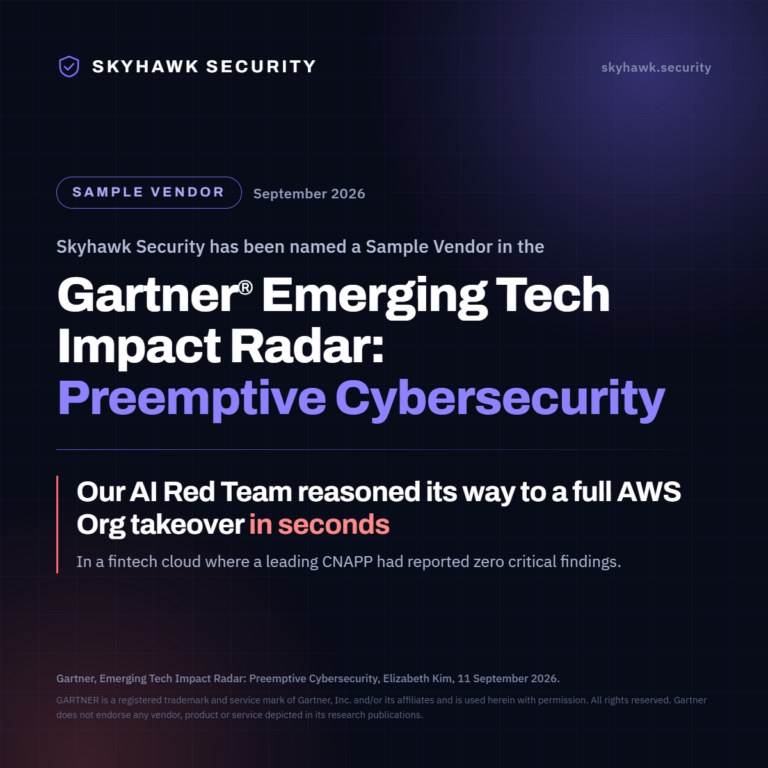
Skyhawk Security’s AI Red Team ran intelligent simulations against a digital twin copy of a Fintech’s cloud and was able to achieve a full AWS organization take over in seconds. What was shocking is there were no critical vulnerabilities, no serious alerts across any of their security platforms, and permissions and roles were managed appropriately. Skyhawk’s AI Red Team was able to dynamically manipulate legitimate configurations in the cloud to achieve a full AWS Org take over. That is game over.
Skyhawk’s key differentiators are:
Adversarial AI red teaming, not graph inference. CNAPPs infer attack paths statically. Skyhawk proves them. Simulations run against a digital twin of the customer’s cloud inside the SaaS platform, so production and people are unaffected, with attacks generated by adversarial AI rather than pre-scripted playbooks.
Weaponization-based prioritization tied to asset value. Skyhawk delivers validated, weaponized threats ranked by the business value of the at-risk asset, with attack plan analysis attached, reducing CNAPP alert fatigue by up to 99% against a baseline where critical findings take three to four months to remediate.
Closed purple-team loop with rehearsed response. Each simulated attack step is mapped to a detection indicator, ensuring compensating controls exist while dev teams work through remediation. Responses are then rehearsed in a simulation twin to confirm they halt the attack without breaking production and turning unpatchable posture debt into trusted runtime coverage.
Want to learn more? Book a meeting today!
Gartner subscribers can read the full report at https://www.gartner.com
Gartner’s Hype Cycle for AI in Supply Chain, 2026 by Christian Titze, Balaji Abbabatulla, Steve Daughertyon July 24, 2026.
GARTNER and Hype Cycle are a trademark of Gartner, Inc. and its affiliates. Gartner does not endorse any vendor, product or service depicted in its research publications, and does not advise technology users to select only those vendors with the highest ratings or other designation. Gartner research publications consist of the opinions of Gartner’s research organization and should not be construed as statements of fact. Gartner disclaims all warranties, expressed or implied, with respect to this research, including any warranties of merchantability or fitness for a particular purpose.