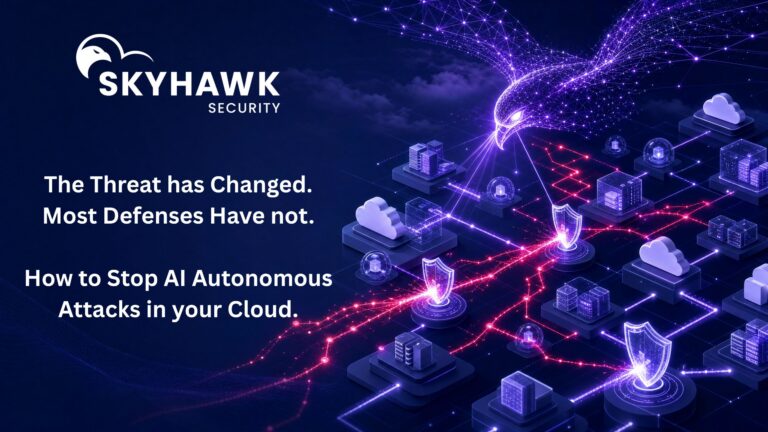
How to Stop AI Autonomous Attacks in your Cloud.
For years, cybersecurity attacks were completely created and executed by humans, and humans are slow. Humans make mistakes and they need time to find a foothold and move laterally through the cloud to find something valuable. This is no longer the case.
Gartner® latest research: Cybersecurity Threat: AI-Augmented Attacks opens with the following statement:
“Following the Mythos Preview and GPT 5.5-Cyber release, CISOs and CIOs are highly concerned about the increased risks from threat actors leveraging AI. Because there is more uncertainty than signals, cybersecurity teams must evolve their defense to thwart the impacts of these AI-augmented attacks.”
Social engineering, deepfake impersonation, LLM driven vulnerability discovery, and automated post-breach kill chain execution are all documented in real attacks observed in the past 12 months.
The FortiGate incident is perhaps the most instructive example. An AI-augmented threat actor, which Amazon Threat Intelligence characterize as relatively unsophisticated, successfully compromised over 600 devices across 55 countries. No zero-days. No elite tradecraft. Just AI, applied systematically to a known vulnerability, at a scale no human team could replicate manually. The lesson is not that the attacker was brilliant. The lesson is that AI made a mediocre attacker dangerous.
Gartner® says: “Sophisticated AI-augmented kill chain automation will drive an evolution of postbreach activities that might inflate the overall damage of the attacks.”
This is the new threat model. And it exposes a fundamental weakness in how most organizations defend their cloud environments today.
Your current cloud security is not holding up.
The dominant cloud security paradigm of scan, alert, prioritize, remediate was designed for a world where attackers moved at human speed. It generates enormous volumes of findings. The average enterprise cloud security team receives thousands of vulnerability alerts per day. The vast majority go unactioned, not because security teams are negligent, but because the signal-to-noise ratio makes meaningful prioritization nearly impossible.
The problem is structural. Conventional CNAPP and CSPM tools are built to answer a static question: what is misconfigured or vulnerable right now? They cannot answer the question that actually determines whether a breach occurs: which of these exposures will an attacker actually weaponize, in what sequence, against which assets, and how quickly?AI-powered attackers do not wait for patch cycles. They do not respect the queue of unactioned alerts, and will use this to their advantage.
Gartner research notes that: “The rise of of LLM-driven vulnerability discovery and the evolution of attack kill-chain automation tooling predates Mythos Preview, OpenAI Daybreak and Microsoft MDASH. Progress of LLM-driven vulnerability discovery is offering more initial breach vectors to attackers and changing the nature and automation of postbreach activities.”
The average human response time to a cloud threat is six hours. In an AI-augmented attack, six hours is the difference between an alert and a breach.
“CISOs cannot wait for best practices and mature technologies to counter AI-augmented attacks. They must prepare for plausible emerging threats before strong evidence appears.”
Preparation, in this context, does not mean buying more tools that generate more alerts. It means fundamentally changing the question your security program is designed to answer — from what is exposed? to what will be attacked, and can I stop it before the attacker gets there?
Skyhawk Security: Built for the AI Attack Era
In our opinion, Skyhawk Security was designed from the ground up to answer that second question. Its approach rests on three interlocking capabilities that, together, deliver what the industry is beginning to call Preemptive Exposure Management the practice of identifying and eliminating attack paths before a threat actor can walk them.
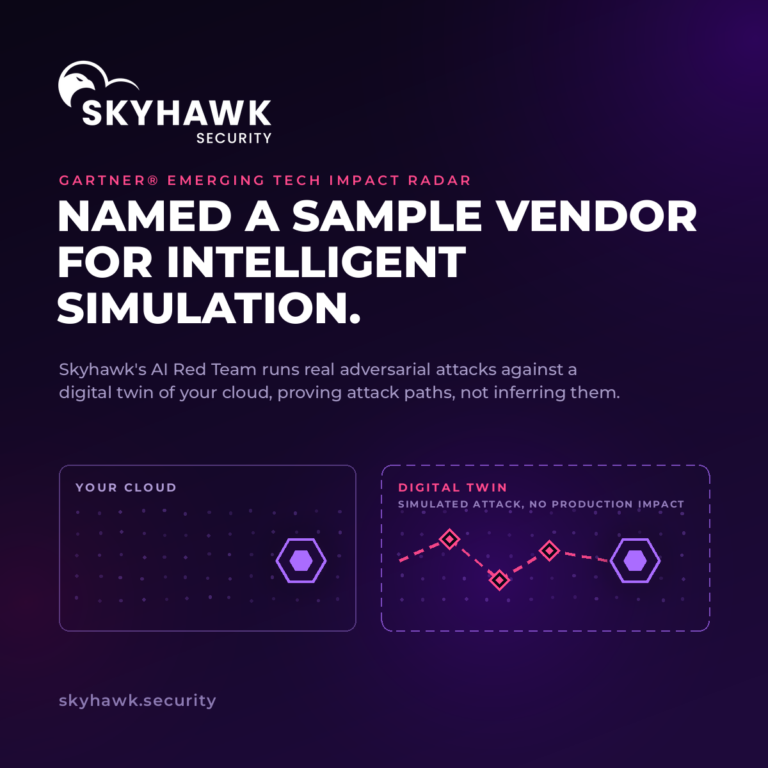
The Digital Simulation Twin
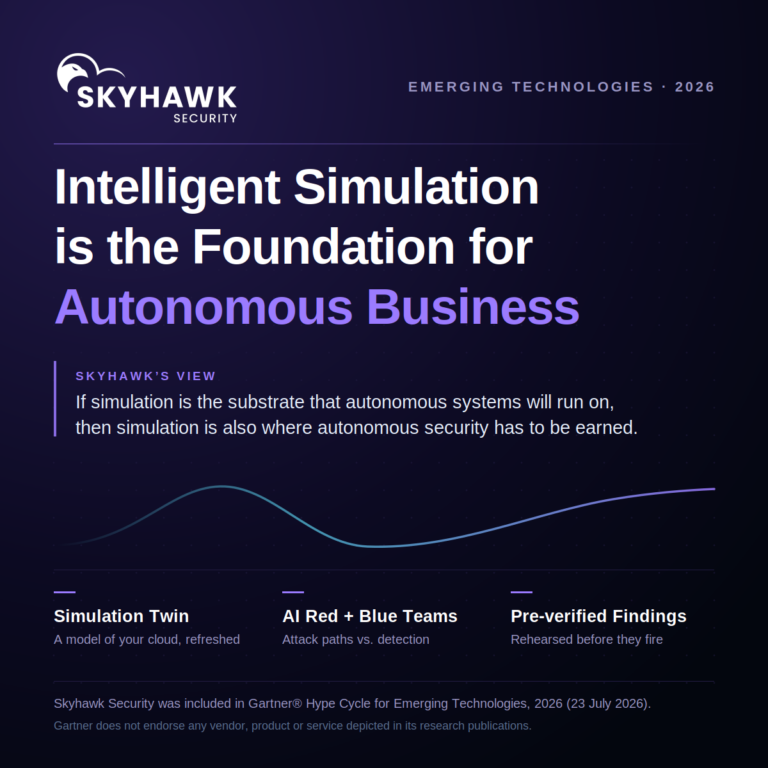
At the core of Skyhawk’s platform is a continuously updated digital simulation twin of your live cloud environment. This is not a static snapshot or a periodic scan. It is a dynamic, living model that reflects your cloud architecture, your deployed workloads, your identity configurations, your security controls, and the relationships between all of them — updated in real time as your cloud changes.
The twin serves a critical purpose: it gives Skyhawk’s AI Red Team a safe, accurate environment in which to simulate adversarial behavior without touching production systems. Every change to your cloud — a new IAM role, a modified security group, a newly deployed workload — is reflected in the twin, ensuring that simulations are always current and architecturally accurate. In a cloud environment that changes hundreds of times per day, this continuous fidelity is not a feature. It is a prerequisite for meaningful security validation.
The AI Red Team
Skyhawk’s AI Red Team operates continuously against the digital twin, executing intelligent attack simulations that mirror the behavior of real threat actors — including AI-augmented ones. These are not generic, template-based penetration tests. They are custom simulations, built to reflect the specific architecture, security controls, and asset topology of your cloud environment.
The simulations include the full range of attacker behaviors that define modern cloud intrusions: the dynamic manipulation of cloud assets to establish footholds, the abuse of misconfigured identities and overprivileged roles to escalate permissions, lateral movement across cloud services and accounts, and the chaining of individually low-severity exposures into high-impact attack paths that lead directly to your most valuable business assets.
Critically, the AI Red Team simulates the behavior of an attacker who is using AI. It does not assume a slow, methodical human adversary. It assumes an adversary that can enumerate your environment at machine speed, identify the most efficient path to a high-value target, and exploit identity and configuration weaknesses in ways that bypass controls designed for human-speed attacks. This is the threat model that matters in 2026.
Business-Value Driven Prioritization
Not all cloud assets are equal. A misconfigured storage bucket containing marketing collateral is a different risk than a misconfigured identity with access to your customer database or your financial systems. Skyhawk’s platform understands this distinction.
Every exposure, identity risk, posture gap, and simulated attack path is prioritized not merely by technical severity, but by the business value of the asset at risk. Skyhawk maps the blast radius of each simulated attack to the assets it would ultimately compromise and weights the urgency of remediation accordingly. Security teams receive a clear, ranked picture of what matters most — not a flat list of thousands of findings sorted by CVSS score.
This business-value lens extends to identities and cloud assets alike. Skyhawk continuously evaluates which identities have access to high-value assets, which of those identities carry exploitable weaknesses, and which combinations of identity misconfigurations and cloud posture gaps create viable attack paths. The result is a security posture that is aligned with what the business actually cares about protecting, not just what is technically misconfigured.
Continuous Cloud Security
Gartner recommends: “Implement or expand programs like continuous threat exposure management, identity threat detection and response and automated security control assessments, to harden defense proactively and reduce the organization’s exposures before initial compromise.”
In our opinion, this is precisely the operating model Skyhawk delivers.
Traditional penetration testing produces a point-in-time report. By the time the findings are reviewed, prioritized, and remediated, the cloud environment has changed; new workloads deployed, new identities created, new security group rules modified. The report is already partially obsolete. In a cloud that changes continuously, security validation must change continuously too.
Skyhawk’s AI Red Team runs without pause. Every change to the cloud environment triggers a re-evaluation of the attack surface. New exposures are identified and prioritized within hours, not weeks. Attack paths that were closed by a remediation are confirmed closed. New paths created by a configuration change are surfaced immediately. The security posture is not a quarterly assessment, it is a live, continuously validated state.
This continuous validation loop also drives continuous self-improvement. As the AI Red Team executes simulations and observes how security controls respond, it feeds those observations back into the platform’s detection and response capabilities. Controls that are effective are confirmed. Controls that fail to detect or block simulated attack behaviors are flagged for hardening. Over time, the platform’s understanding of your environment deepens, its simulations become more sophisticated, and your security posture improves, automatically, without requiring manual tuning or additional headcount.
The principle is simple. The execution is not.
The strategic logic of preemptive exposure management is straightforward: find the attack paths before the attacker does, eliminate the ones that lead to your most valuable assets, and do it continuously so that the picture never goes stale. But executing this against a modern cloud environment, one that is architecturally complex, constantly changing, and increasingly targeted by AI-powered adversaries, requires a platform that can operate at the same speed and sophistication as the threat.
In our opinion, Skyhawk Security is that platform. Its digital simulation twin ensures that every simulation reflects the real state of your cloud. Its AI Red Team simulates the full range of adversarial behaviors, including the AI-augmented tactics that are reshaping the threat landscape. Its business-value-driven prioritization ensures that remediation effort is directed where it matters most. And its continuous operation means that your security posture is always current, always validated, and always improving.
The FortiGate incident demonstrated what happens when an AI-augmented attacker finds an unvalidated exposure at scale. The question for every cloud security leader is not whether a similar attack will be attempted against their environment. It will be. The question is whether their security program will find the path first.
With Skyhawk, the answer is yes.
See it for yourself! Sign up for our free 30-day trial.
Want to go deeper? Read our differentiators whitepaper for the full picture, then book a meeting with our team to discuss your specific environment
Gartner subscribers can read the full report at https://www.gartner.com
Gartner, Cybersecurity Threat: AI-Augmented Attacks, by Jeremy D’Hoinne, Peter Firstbrook, Nahim Fazal, Akif Khan published May 28, 2026.
GARTNER is a trademark of Gartner, Inc. and its affiliates.