Episode 3: AI Red Team
The AI Red Team is the capability that ties the proprietary AI platform and the Digital Twin together into a continuous, autonomous security function. It provides an Adversarial View of the vulnerabilities, cloud security controls, and cloud architecture so security teams can understand how threat actors will dynamically manipulate them to their advantage to breach your business. This enables security teams to prioritize vulnerabilities based on the business value of the at-risk asset – not the criticality of the alert. A critical alert on a test environment is not nearly as dangerous as a medium vulnerability on a high-value business asset. This is what Skyhawk Security’s AI Red Team will definitively identify for your security team so that you can achieve your true goal, cloud risk reduction.
What is red teaming?
Traditional red teaming is a periodic exercise. A team of security professionals, either internal or contracted, comes in with a defined scope, a book of known attack techniques, and a time-limited engagement. They find what they can find within the constraints of the engagement, write a report, and leave. The environment changes. The next engagement starts from scratch.
According to Gartner® Research, The Future of Pen Testing Is Continuous Offensive Security Testing, “The Future of Pen Testing is continuous, business-risk-driven, and guided by threat intelligence. Embedding continuous validation into operational workflows ensures that organizations proactively prioritize and address the real-world attacks that target the most critical and impactful assets.”
In Skyhawk’s opinion, once you finish reading our blog, you will understand how Skyhawk Security can help you achieve this.
Skyhawk’s AI Red Team
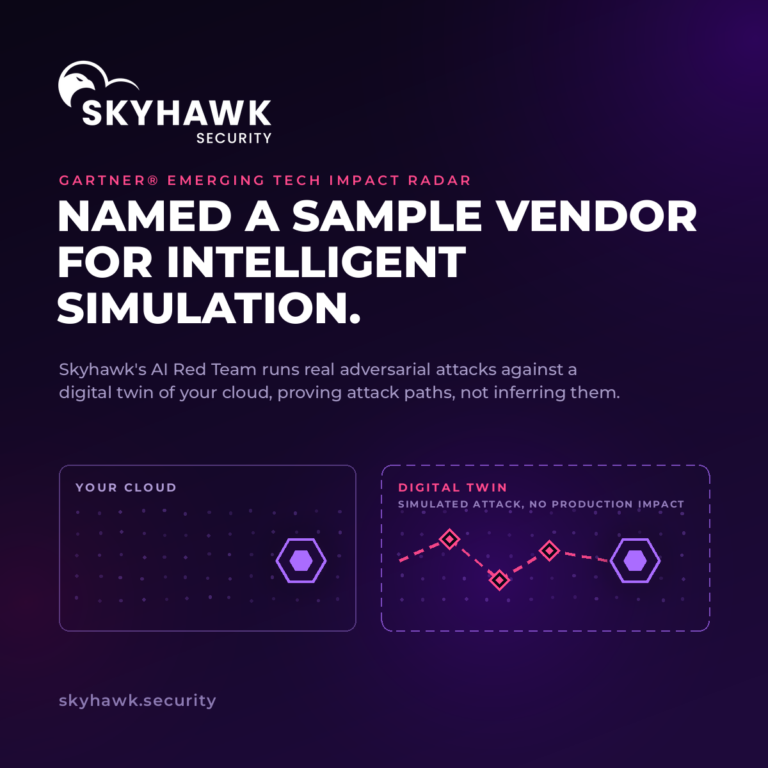
The Skyhawk AI Red Team operates continuously, not periodically. It does not work from a book of known, pre-scripted attacks executed within a framework of rules. It leverages intelligent simulation to design attacks based on the specific cloud architecture and security controls of the customer’s environment, custom attack sequences that reflect the actual attack surface, not a generic one. The attacks are executed in a digital twin, which is a digital representation of the cloud architecture and security controls. This is not a one-to-one copy of the environment as that would be cost-prohibitive.
Additionally, the red teaming exercise with Skyhawk Security mimics an attack. There are no rules of engagement as threat actors do not respect rules of engagement. Security controls cannot be truly validated to hold when there are rules of engagement limiting the activities and actions of the attack.
A distinction between traditional pen testing and Skyhawk’s Adversarial AI can be summarized as follows:
| Dimension | Traditional Pen Testing | Skyhawk AI Red Team |
| Frequency | Periodic (quarterly, annually) | Continuous |
| Attack design | Pre-defined playbook | Custom, environment-specific |
| Environment | Static snapshot | Dynamic, live Digital Twin |
| Scope | Defined and bounded | Comprehensive, unbounded |
| Output | Point-in-time report | Continuous, prioritized findings |
| Disruption risk | Moderate to high | Zero (Digital Twin) |
| Permission manipulation | Limited | Full dynamic escalation simulation |
| Rules of engagement | Bound by a framework | Mimics the behavior of threat actors AKA no rules |
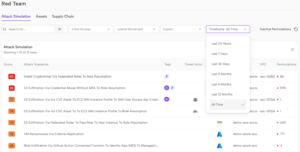
Figure 3. The red team shows which specific attack simulations have been executed and which affect crown jewels.
Built on the AI Red Team capabilities to dynamically manipulate the environment is what enables a core use case of Adversarial Exposure Validation (AEV). This is the confirmation that a vulnerability is not just theoretically exploitable, but actually weaponizable in the customer’s specific environment, against the customer’s specific assets, given the compensating controls in place.
Find and Prioritize the Weaponized Vulnerabilities
Not all vulnerabilities and exposures are equal. A vulnerability that exposes an empty test environment, even a critical one, is not nearly as important as a medium severity vulnerability that exposes valuable financial data. This is the difference between weaponizable and exploitable. A critical exploitable vulnerability that is a road to nowhere is not critical to remediate.
Skyhawk’s AI Red Team looks at the security controls and cloud architecture and then acts as a threat actor, dynamically manipulating exposures and vulnerabilities, to try to gain access to valuable cloud assets.
The criticality of the vulnerability is not related to the technical configuration of the vulnerability; it is directly related to the value of the business asset that will be breached.
Collaborative Red Teaming
Skyhawk Security does not replace pen testing. Skyhawk can be used in a collaborative way to help red teams and pen testers focus on specific aspects of your cloud security controls that need an additional layer of validation.
Prioritize Threats for True Cloud Risk Reduction
Skyhawk Security’s AI Red Team supports key use cases such as unified vulnerability management to prioritize the vulnerabilities in your cloud based on the business value of the at-risk asset. This is what matters to reduce cloud risk and protect your business.
The report also states that, “COST combines automation, AI and human expertise to simulate adversarial tactics to validate exposures before attackers exploit them. Using methods such as penetration testing, red teaming, and attack simulations, it validates weaknesses proactively and strengthens defensive and response capabilities against evolving threats.”
If you read Skyhawk Security’s Whitepaper that discusses our differentiators, you will learn more about our Digital Twins and Intelligent Simulations, which validate weaknesses proactively. After you read it, book a meeting with us today! Or, Sign up for our free trial today!
Gartner subscribers can read the full report at https://www.gartner.com/document-reader/document/7558445
Gartner, The Future of Pen Testing is Continuous Offensive Security Testing by Dhivya Polle, Carlos De Sola Caraballo, Mitchell Schneider, published March 6, 2026.
GARTNER is a trademark of Gartner, Inc. and its affiliates.