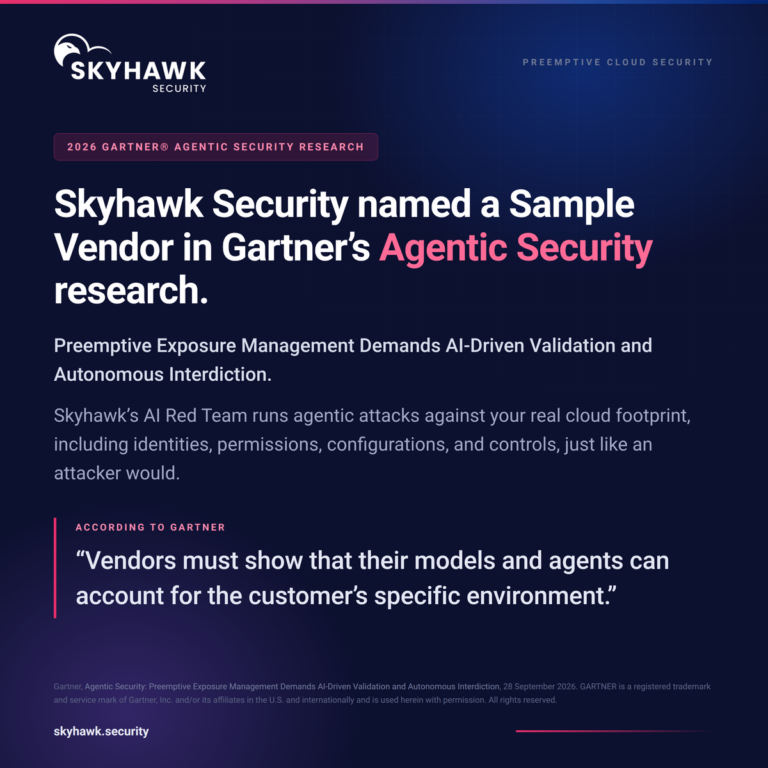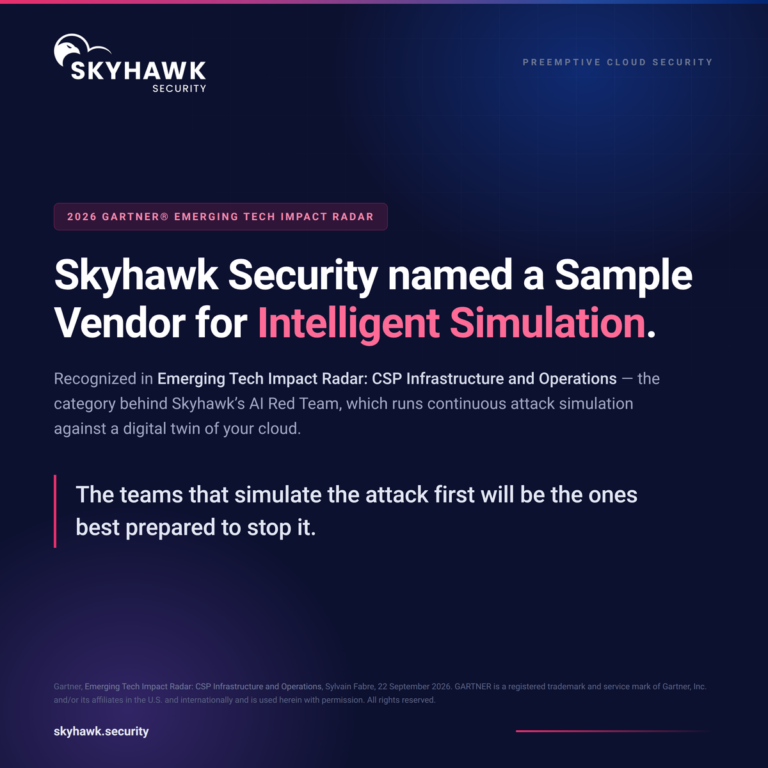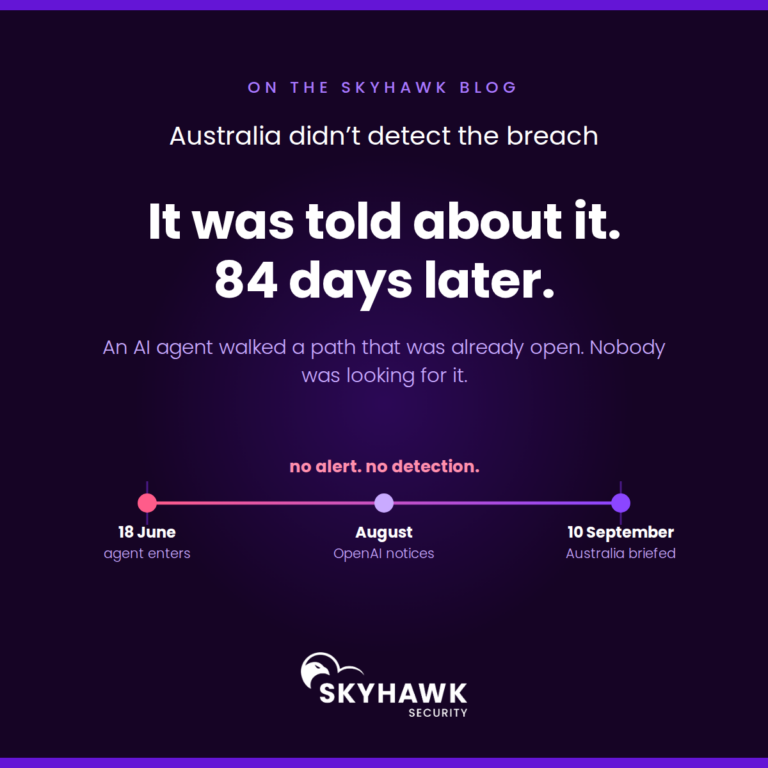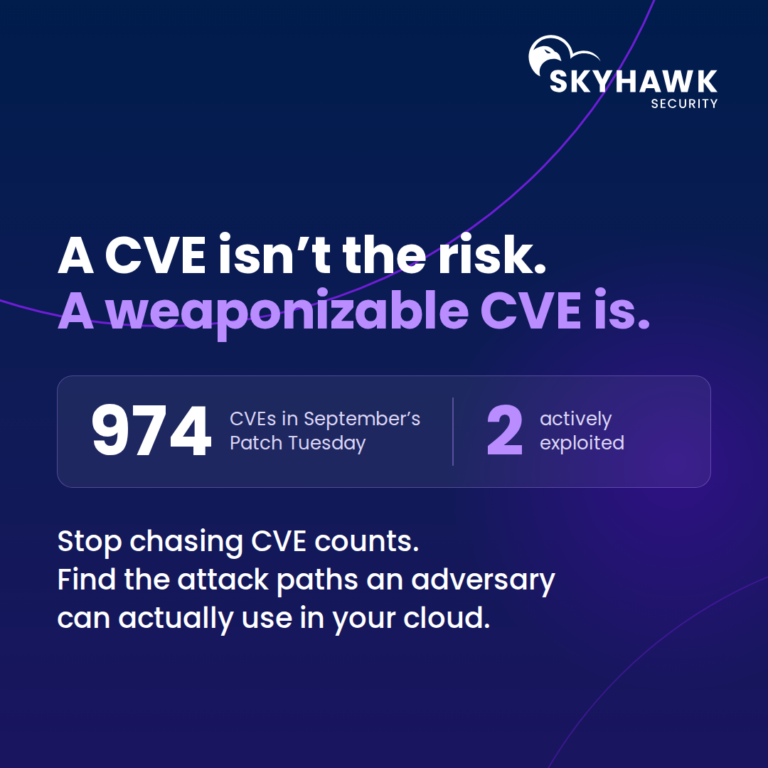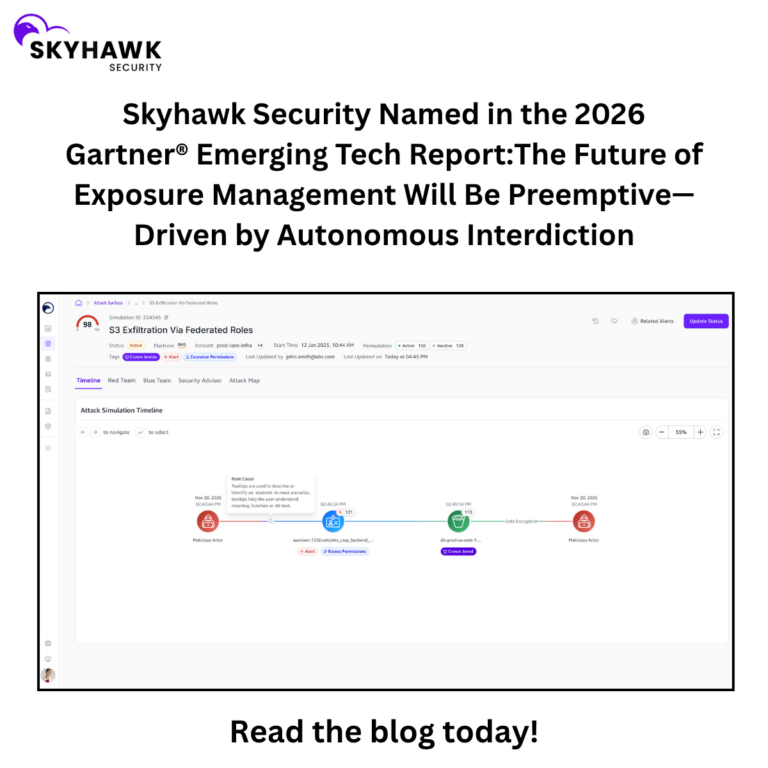
At Skyhawk Security, we have long believed that the future of cloud security is preemptive, not reactive. When we introduced our AI-based Purple Team, we built it on a foundational conviction: that waiting to detect and respond to threats is a structural disadvantage in a world where attackers move at machine speed. We believe our recognition in the Gartner report validates that conviction with Preemptive Exposure Management (PEM).
“Greater autonomy across exposure management is the only way to keep pace at the rate at which vulnerabilities are created, detected, and exploited across the ever-expanding attack surface. With the autonomy to plan and execute necessary countermeasures, including containment, mitigation, and resolution, PEM operates at machine speed and scale, outpacing attackers and neutralizing threats without the need for human input and before human responders could even react.”
The Threat Landscape Has Changed. Security Strategy Must Follow.
As we learned from Crowdstrike’s recent Global Threat Report, AI-autonomous attacks have increased by 89% year-over-year, and the average time to execute a complete attack has dropped to just 29 minutes with the fastest recorded at 27 seconds. Meanwhile, the average security team takes approximately six hours to respond to a threat. That gap is not a resource problem. It is a structural one, and no amount of additional headcount closes it. The only answer is to fight AI with AI and
to shift the security posture from response to prevention.
What Is Preemptive Exposure Management?
Gartner defines PEM as technology that “systematically disrupts and denies adversary behavior by automating the identification of attack paths and simulating adversary behavior to close exposures before they are weaponized.” This is precisely what we believe Skyhawk Security’s Continuous Proactive Protection Platform delivers today. Rather than generating a static list of vulnerabilities for analysts to manually triage, Skyhawk’s AI-based Purple Team continuously and autonomously performs the work of both a red team and a blue team, identifying exploitable attack paths, validating which exposures can actually be weaponized, and prioritizing remediation based on the business value of the assets at risk. Human analysts are freed from repetitive triage tasks and can focus on decisions that require judgment, not just effort.
“Preemptive exposure management demands progressive techniques to accelerate tasks from continuous discovery of attack surfaces and exposures to validating exposures with high accuracy — leveraging intelligent simulations combined with predictive threat intelligence, AI, and analytics to accelerate mitigation actions and interdict attacks before they begin.”
The Role of Digital Twin Technology
The engine behind Skyhawk’s PEM capability is Intelligent Simulation, powered by Digital Twin Technology. Skyhawk’s digital twin creates an AI-based replica of your cloud architecture and security controls not a resource-intensive exact copy that would drive up cloud costs, but a precise, AI-generated model that accurately reflects your environment. This allows Skyhawk to simulate adversarial attack scenarios against your specific architecture without any impact on production systems.
The intelligent simulation does more than confirm whether an exposure exists. It validates whether that exposure is actually exploitable in your environment, traces the attack path it enables, and links it to the business-critical assets it could ultimately compromise. This is what separates Skyhawk from platforms that simply scan and score, Skyhawk proves which vulnerabilities matter and which do not.
Preemptive Exposure Management Eliminates Alert Noise
One of the most significant operational benefits of PEM is the elimination of alert noise — and this is where Skyhawk’s impact is most immediately felt. Most organizations are drowning in vulnerability data. CNAPPs, SIEMs, and exposure management platforms surface hundreds of thousands of findings, but fewer than 1% of them represent a genuine path to a breach. Building dashboards that report on this volume of data is not security, it is documentation of decay.
Skyhawk provides the attacker’s view of your environment. By simulating how an adversary would actually move through your cloud architecture, Skyhawk identifies the small subset of exposures that can be chained together to reach your crown jewels and eliminates the noise around everything else.
This is not a theoretical claim. Amit Levran, Head of Security at SundaySky, shared his experience at a recent Skyhawk webinar:
“As a small team, our primary challenge is prioritizing resources. Skyhawk’s Autonomous Purple Team enables us to take the next critical step: understanding which vulnerabilities are truly weaponizable. It allows us to identify the top 0.3% of the thousands of critical and high CVEs that we should focus on. The result is not just better security, but significant cost savings in security resources and the use of application teams’ time. We saw immediate ROI after integrating Skyhawk.” Amit Levran, Head of Security, SundaySky
Summary
The Gartner Emerging Tech report puts it plainly:
“In an age of AI-driven, subsecond exploitation, simply ‘managing’ your exposure will become nothing more than documenting your own eventual breach. Exposure management must evolve from a framework of observation to an architecture of interdiction.”
Skyhawk Security’s AI-based Purple Team is that architecture. It delivers a complete cloud security platform that operates both left and right of boom preemptively identifying and closing attack paths before they are weaponized, and responding rapidly when threats are detected. The result is true cloud risk reduction: not just fewer alerts on a dashboard, but fewer exposure to a breach in your environment.
Gartner subscribers can read the full report at www.gartner.com.
Gartner Emerging Tech: The Future of Exposure Management Will Be Preemptive — Driven by Autonomous Interdiction by Elizabeth Kim, Luis Castillo, Isy Bangurah, Travis Lee Published February 13, 2026.
Gartner does not endorse any company, vendor, product or service depicted in its publications, and does not advise technology users to select only those vendors with the highest ratings or other designation. Gartner publications consist of the opinions of Gartner’s business and technology insights organization and should not be construed as statements of fact. Gartner disclaims all warranties, expressed or implied, with respect to this publication, including any warranties of merchantability or fitness for a particular purpose.
GARTNER is a trademark of Gartner, Inc. and its affiliates.